Kitchen Line Ready Position Fundamentals
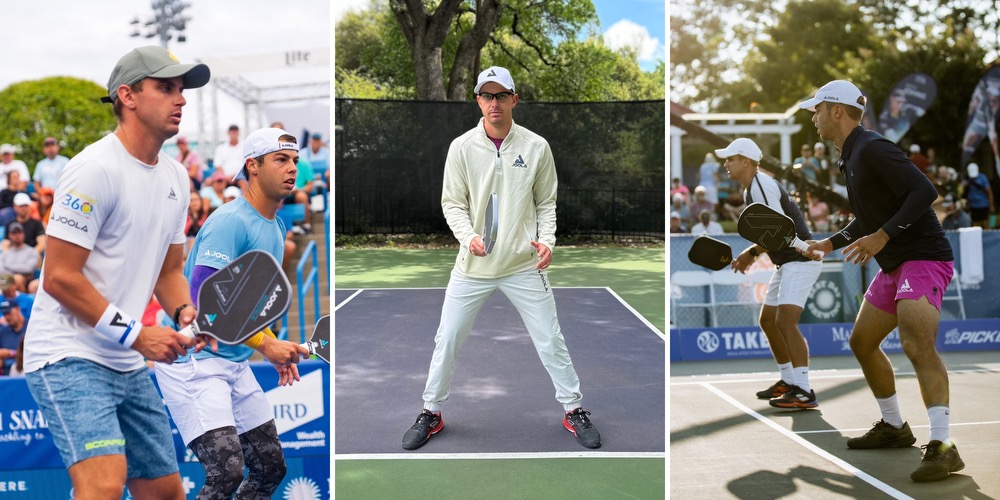
The kitchen line ready position is particularly important since a player’s reaction time is often limited. The ready position is something that is often taught incorrectly and there are a few common myths that will be busted in this section.
1. Stance – feet/knees/toes:
- Feet should be set slightly wider than shoulder width apart to widen base and lower center of gravity.
- Knees should have athletic bend in them to increase stability and mobility. This also makes a player a smaller target to opponents by keeping more of their body below the level of the net.
- Toes should face slightly outwards to open up hips for more flexible rotation and to comfortably shift body weight left and right by leaning body weight into one leg more than the other. This allows a player to:
- Create space for body shots
- Lean left and right to cover wider shots
- Reach forward at any angle with balance
- Provides incrementally more space to advance towards the kitchen line
- Distance from Kitchen Line: A player should position themselves as close as possible to the kitchen line without risking a foot fault to:
- maximize reach
- minimize space opponents have to hit down to the feet
- maximize the downward hitting angle into the opposing court and to opponents’ feet
Establishing a solid position to swing from, is particularly helpful to beginner and low-level players who benefit significantly from the increase in overall coordination by establishing a stable base.
2. Paddle Position
- Height
The paddle head should rest at waist level, generally in line with the height of the net. Proper volley swings are characteristically from low to high so it is important to keep the paddle at net height in order to allow the paddle to be swung in an upward motion. This allows a player to generate slight topspin by raising their hands quickly. Net height is also where most accelerated shots will end up, so the paddle is placed closer to where shots are likely to be.
It is a common myth that the paddle should be raised up high in the ready position, and it is often surprising to players that the correct paddle position is relatively low. It is important to have a clear concise answer prepared for this reason, addressing why the correct paddle position height is at net level. The following two factors are the ones best highlighted:
- The paddle must be low enough to be swung upwards for correct swings to occur.
- Most high-paced shots will pass at waist level, placing the paddle closer to the ball. High velocity shots hit higher than the shoulders will frequently go out-of-bounds.
- Forehand/Backhand
All attacking angles being equal, a player should not tip their hand to opponents by favoring one side heavily over the other in their ready position. The paddle angle should be set almost neutral, slightly favoring the backhand side. Favoring the backhand is preferred because, when in a recommended neutral grip, a player can maintain a forward-facing paddle face over the widest distance across the body. It will sometimes be necessary for a player to shield the full width of their body with one side of the paddle when pressed for reaction time.
It is a common myth that a player should heavily favor their backhand in the ready position. This philosophy has several drawbacks:
- Predictability – showing a heavy backhand ready position clearly telegraphs a player’s intentions to the opponent, which creates a predictable weak zone on the forehand side of the body.
- Severely limits the amount of space a player can cover. One of the advantages of developing a strong forehand volley is the reach a player gains with a forehand. By committing heavily to backhand, a player shrinks the amount of space they are capable of covering.
- Develops a lack of versatility – by heavily favoring and thus hitting mostly backhand volleys, a player curtails their ability to develop their forehand volley. This has a significant negative effect on proficiency when a player is forced to hit a forehand.
- Severely lessens the possibility of developing the forehand volley as a weapon. The forehand volley can become a powerful tool in a player’s arsenal with the reach, power, spin, and stability a forehand has the potential to supply. By heavily favoring backhand, it is unlikely that the forehand will be hit frequently enough to be leveraged as a weapon.
- Instills a defensive mindset. The backhand volley is primarily responsible for strongly protecting a player’s body. By making body protection top priority, it instills a defensive mentality that signals to opponents that a player is more concerned with defending than posing offensive threats.
- Poses a problem when needing to cover middle attacks. In many situations, a right-handed player will be responsible for covering middle attacks with their forehand volley, when playing the left-side of the court. Baseline drives and kitchen line attacks through the middle should be met by a strong forehand counter whenever possible, and heavily favoring backhand as the default makes this very unnatural for a player in such a situation.
- Develops a habit that is hard to break. If a player starts out heavily favoring backhand, it can be very difficult to make a change to their initial response of automatically resorting to backhand.
- Can exacerbate slow reactions – if heavily favoring backhand is meant to make up for slow reflexes, the result will often be to make a player even less effective. If a slow player heavily favors backhand, they are effectively stuck hitting backhands since they are not quick enough to switch over to the forehand. This makes success more likely if the ball is hit directly to the backhand but restricts a player to an option that can only be executed from a relatively limited space. This renders the player completely ineffective for any volley that is hit away from their immediate vicinity.
- The alternative of slightly favoring backhand has significant upside and limited downside. A player will be able to execute proficient backhand volleys from a marginally committed backhand position nearly as well as a fully committed backhand position. However, a more neutral starting position, allows the potential for effective execution on the forehand side as well. Contrary to a heavy backhand position, which severely limits a player’s ability to get to the forehand side, with little added benefit when hitting backhands.
It should be emphasized that favoring one side too heavily (forehand or backhand) will make a player less effective.
- Hand/wrist position
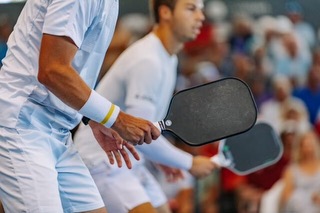
The wrist position should be relaxed/neutral to allow for versatility in adjusting the orientation of the wrist in order to adjust for different types of shots. The paddle head should generally remain slightly above the hand when resting in a neutral position to maintain a strong wrist position to prevent the wrist from collapsing. The relation between the hand and paddle head will change positions when executing specific types of strokes but starting with a stable wrist position is important to prepare each swing in a uniform way. It is common for amateur players to allow their wrist and paddle head to droop into a weak position which reduces stability and makes strokes difficult to replicate consistently.
Example of neutral hand/wrist position while keeping paddle head in a strong position – just above the wrist
3. Elbows
The elbows should be tucked into the body and back to maximize how fast a player can rotate. By keeping the arms tucked into the body, it allows a player to physically spin/rotate their body much like a figure skater maximizing their rotational speed on the ice.
It is a common myth that the elbows should be extended away from the body to place the paddle “out in front”. It is important to be able to list the various advantages of keeping the elbows tucked in for this reason.
When a player keeps their elbows back, they maximize how quickly they are able to rotate their hips and shoulders, and gain the following benefits:
- Loads and increases power
- Provides greater flexibility of contact
- Ability to dodge shots
- Prepares volley swings to be loaded in the proper position, tighter to the body
- Keeps arms relaxed to prevent tiring
It is often useful to contrast these advantages to the disadvantages of making the mistake of extending the elbows “out in front”. Positioning the elbows and arms away from their body results in:
- Slowed rotation
- Decreased stability
- Reduces power by limiting load of the hips
- Reduces reaction time by limiting flexibility of contact
- Makes it more difficult to maintain control over the paddle face at full extension, making it more likely the paddle face will fly open or collapse.
- Tires the arms, leading to fatigue
4. Secondary Hand
For players with a one-handed backhand, the secondary arm should be positioned parallel to the hitting arm, hinging at the elbow to create a roughly 90-degree angle between the upper arm and forearm. Keeping the secondary arm parallel to the hitting arm creates balance and maximizes how fast a player can rotate. When reaching forward with the paddle arm, the secondary arm should extend backwards to maintain balance and create additional power. Keeping the arms parallel allows a player to easily keep track of proper counterbalancing—as the hitting arm goes out, the secondary arm goes back at the same rate/distance. This is impossible if both arms are extended out since one arm must move a far greater distance than the other. Keep your arms equidistant from where they need to travel to. For two-handed backhand players, the hands should connect in the middle to place the secondary hand on the paddle.
5. Torso
It is critical that the torso is rotated in the direction the ball is being struck from, to point the blade of the paddle towards the ball. Failure to track the ball with the paddle will cause a player to be late reaching to the incoming angle of the ball, costing them valuable time if the ball is played to them. Tracking the ball by rotating the torso applies to all directions – whether the ball is positioned cross-court, straight ahead, or somewhere in between, a player should be turned in its direction.
6. Chest/Shoulders
A player’s chest and shoulders should be tilted slightly forward to shift their body weight onto the balls of their feet for more dynamic movement and to maximize their wingspan when reaching forward. The forward extension should place a player’s nose over their toes.
7. Grip Tension
A player’s grip on the paddle should be relatively loose while maintaining control over the paddle. It is helpful to compare the appropriate tension running through the arms, wrists, and hands, to a boxer who is prepared to defend oncoming punches. Arms are fastest when they are relatively loose but at attention for an immediate controlled but explosive response. Gripping the paddle too tightly will cause tension and slow reactions. While gripping too loosely will cause loss of the feeling of connection with the paddle.
8. Head
The head should be kept level and held steady on the ball to prepare eyes to track the ball from a stable position. A player’s head should remain steady enough to keep an object balanced on their head. This increases overall balance and visual tracking of the ball.
9. Eyes
The eyes should be centered on the where the ball is being struck from to track the ball and movements of the opponent.