Fundamentals and Recommended Grip Types
A player’s grip is their connection point to their paddle, which has a high degree of impact on how they play and execute specific strokes. How the paddle face rests relative to a player’s hand is the single most meaningful factor to the trajectory of any given shot. Grip also affects a player’s ability to generate power and spin, which makes it one of the most basic and important elements to get right in a player’s game.
When starting with a clean slate, it is best to start a player in a neutral versatile grip that can easily be adapted from. More extreme grips such as western or semi-western, should be avoided. Adopting a version of western for the forehand side is standard in a sport like tennis, but more extreme grips do not translate well to pickleball due to limitations on spin and a lower average bounce height to the ball. Any alternative unorthodox grips that are not neutral in nature, should be corrected and adjusted to a proper neutral grip. A neutral grip allows a player to quickly and comfortably switch between forehand and backhand, which is critical when reaction time diminishes as a player approaches the kitchen line.
Adjusting Grip Mid-rally – it is recommended for beginner and low-level players to maintain the same grip to play all shots throughout the rally. Changing grips for different types of shots during a rally can be challenging since reaction time is often limited, and maintaining the same grip offers simplicity for players who are still learning to play basic strokes. Two strokes that adjusting the grip would be acceptable for are serves and returns, which a player can set their grip for before the rally has been set in motion. Serves and returns are also shots a player has more time and distance to adjust their grip post swing to switch back into their usual grip. However, since switching grips is not strictly necessary and has limited additional benefit, it is still advisable for beginner and low-level players to use the same grip for all their strokes.
Grip Pressure – A player should adopt a relatively loose to medium tension grip. It is important to avoid an overly tight grip on the paddle, as it hinders shots that require feel and causes tension that leads to more rapid tiring of muscles, as well as to potential injury. An overly loose grip should also be avoided, as it lacks stability and does not promote connection with the paddle. The ideal grip pressure will be somewhere between these two extremes, but the exact pressure will vary from player to player. The important factor is to avoid extreme ends of the spectrum and for a player to find what is personally most comfortable.
Variety – It is permissible for a player to have either a one-handed backhand or a two-handed backhand or a blend of both variations, depending on the situation. Variety is useful in situations where a player is stretching, imparting different types of spin, or to increase stability or maneuverability.
Two-handed Backhand – A player will often be more comfortable hitting their backhand with two hands if they come from a sport like tennis or can benefit from the additional stability and control that two hands provides. A coach should freely introduce the two-handed backhand to players who may benefit from adding the secondary hand to the paddle. Becoming comfortable hitting a two-handed backhand also becomes useful as a player rises to higher levels of play and can generate more spin and power as well increase stability and maneuverability.
Understanding Strengths and Weaknesses – it is important for a coach to communicate the inherent strengths and weaknesses of specific grips to allow a player to leverage the strengths and minimize weaknesses. All grips come with pros and cons so it is critical to understand what the characteristics of a particular grip are. For example, the continental grip is one of the leading grip options, but typically creates more backhand dominant strokes relative to other grip types.
Recommended Grip Types:
1. Continental Grip:
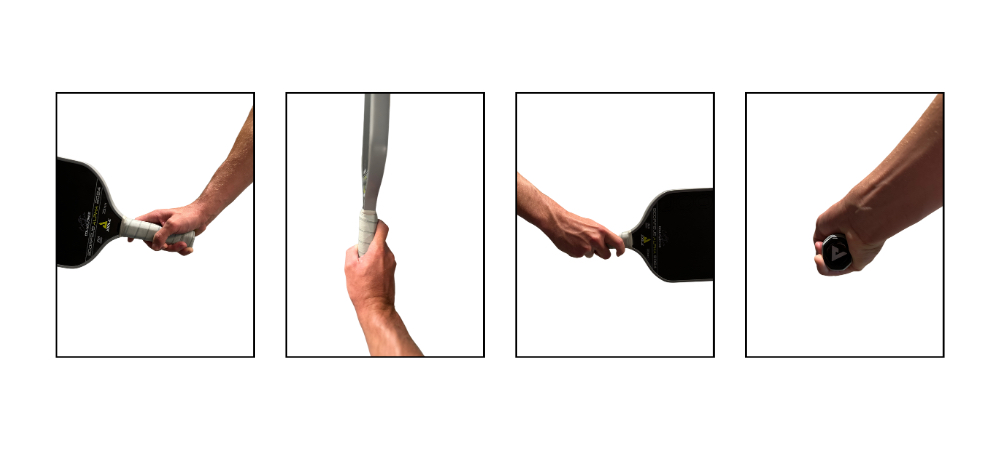
**Balance between resting/securing in the palm and maintaining feel by gripping with the fingers.**
- Description:
- The index knuckle rests more “on top” of the grip as if the paddle were a hammer. A player can also “shake hands” with the paddle when holding the paddle blade down.
- Advantages:
- Has balance between forehand and backhand which makes it the most versatile grip.
- Makes it easy to slice and dig under low forehands and backhands
- Strong backhand volley
- Strong backhand attacks
- Disadvantages:
- Difficult to create topspin on forehand drives and returns
2. Eastern Grip:
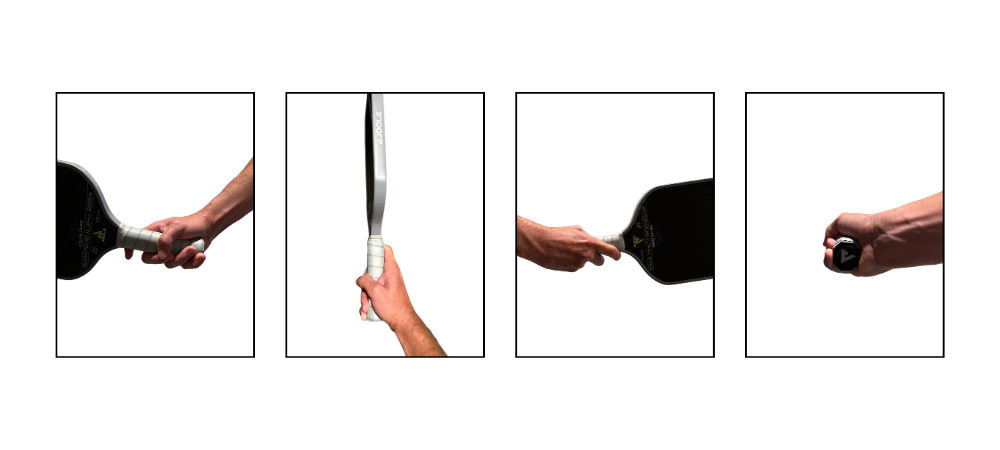
**Balance between resting/securing in the palm and maintaining feel by gripping with the fingers.**
- Description:
- The index knuckle rests more “behind” the grip, creating a stable position if pressure is applied on the paddle in the direction of the palm.
- Advantages:
- Strengthens forehand volleys
- Strengthens forehand attacks
- Increases the ability to create topspin on forehand attacks
- Increases power and ability to create topspin on forehand drives and returns
- Disadvantages:
- Slightly weakens backhand volleys
- Slightly weakens backhand drives and returns
3. Ping Pong Grip
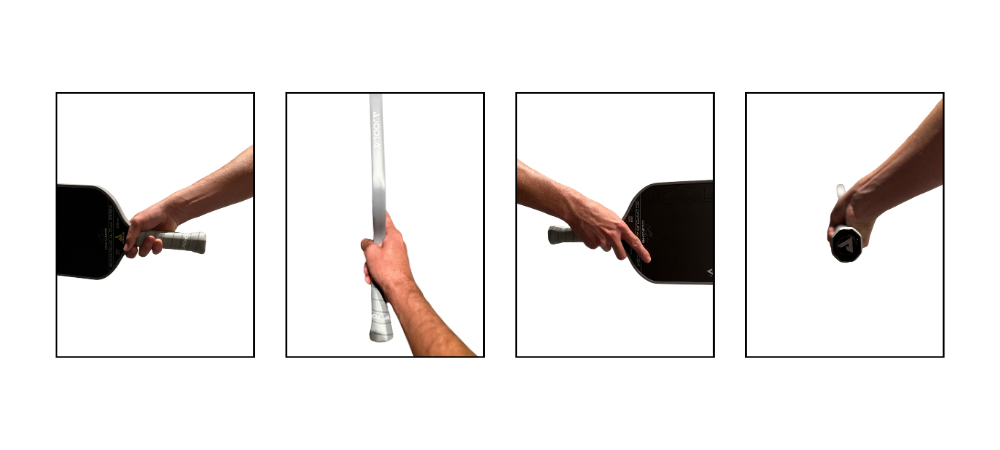
- Description:
- Choking up on the paddle within the throat area to place the index finger up on the paddle face. This creates a strong position, locking the paddle face between a player’s index finger and thumb.
- Advantages:
- More overall control over the paddle face. Particularly for touch shots and defending.
- Can adjust the angle of the paddle face open or closed quickly.
- More maneuverability in reflex exchanges.
- Increases strength to the backhand volley.
- Disadvantages:
- Decreases leverage, power, and reach. Particularly for overheads, drives, and stretching laterally or forward.
- Makes forehand volleys more difficult. Particularly in front of the body.
- Decreases flexibility in the range of shots that can be created.
4. Two-handed Backhand Grip:
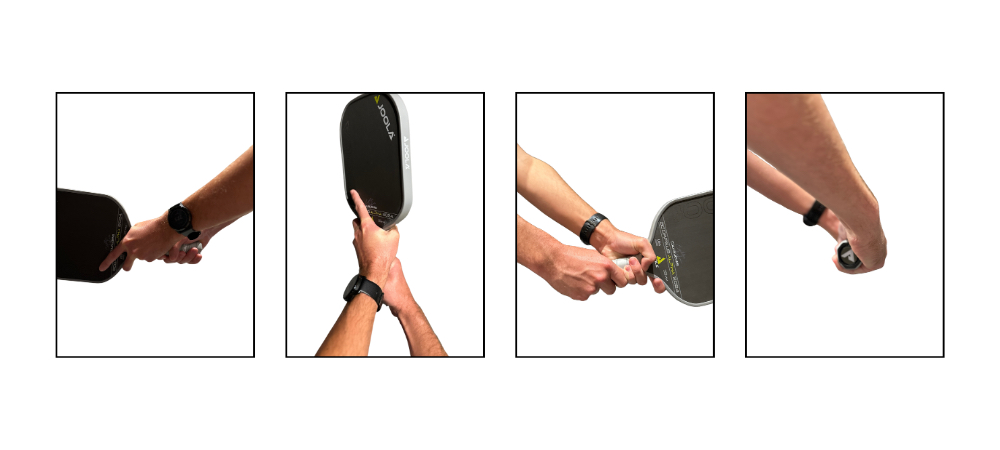
- Description:
- A proper two-handed backhand grip is adopted by wrapping the palm of the secondary hand around the back of the grip with the index finger resting up on the paddle face, the middle finger resting underneath the blade, and the ring and pinky fingers around the handle. By keeping the index finger on the back of the paddle face, a player can more easily keep the direction of the paddle face oriented. The middle finger should provide stability at the bottom side of the paddle and the grip should rest in a player’s palm to create a stable position.
- It should be noted that not all paddles have an extended handle to make it feasible to add the secondary hand to the grip. By positioning two fingers above the grip itself, it makes it more likely that a player can successfully add their second hand onto the paddle. If a player lacks the space to effectively place their secondary hand, a change in their paddle selection may be required to utilize a two-handed backhand.
- Advantages:
- Ability to generate topspin more easily
- Increased power-Increased stability
- Increased maneuverability
- Disadvantages:
- Limits reach
- Makes hitting slice less natural
- Using secondary hand can be awkward to learn initially
- Makes covering body shots less natural